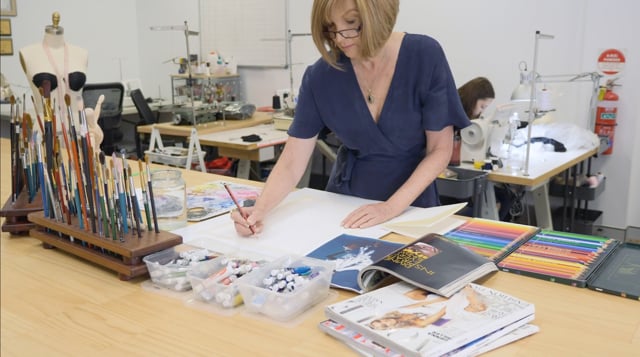
Nada Murphy, Ecological Warrior, Perth WA
Why We Need Artists: A Conversation with Nada Murphy
Proartika: When did you first know you were an artist?
Nada Murphy: People ask how long I’ve been an artist, and my answer is really “all of my life.” I remember, even as a very young child, having a sense that drawing and making images was connected to being an artist, even if I didn’t yet have the words for it. By the time I was five, I drew a portrait of my teacher in what would now be called pre‑primary, and she kept the drawing at the end of the day because everyone said it was such a good likeness. That was the first time a piece of my work was given away, and it quietly confirmed something in me.
Early education and influences
Proartika: How did your school years shape your path?
Nada Murphy: In high school I enrolled in art and defended that turf furiously, because I was absolutely determined I was going to be an artist. I also studied etching and printmaking then, which has remained one of the threads in my practice. At the same time, I enrolled in mathematics and discovered this very enquiring side of myself, always wanting to know how things work and how they fit together.
Proartika: What did university add to that picture?
Nada Murphy: I went to Melbourne University in the 1970s, one of the first women in my family to go to university at all. I enrolled in an Arts degree with Fine Art, and studied Renaissance art, psychology and even some criminology, while also firmly discovering I was not an economist. When people encouraged me to go to university, the message was often “you can always paint later,” which carried that subtle idea that the academic path was more valued than the artistic one.
Moving west and expanding mediums
Proartika: What brought you to Western Australia and what did you study here?
Nada Murphy: After leaving Melbourne University, I came to Western Australia as a very young woman and went to Perth Technical College to study painting, drawing and printmaking. Those disciplines formed the backbone of my practice for many years, and in this current space you can still see that foundation.
Proartika: When did glass and other materials enter your practice?
Nada Murphy: Over time, I was drawn to other techniques, especially glass. Working with glass had fascinated me for a long time, but it’s a difficult material to learn and handle, so it took years before I could really bring it into the work. Around 13 or 14 years ago, which coincides with when I began working seriously on this river system, glass and its wire-reinforced forms became a way to speak about earthiness, crust, salt and riverbanks.
Rivers, childhood and ecology
Proartika: Why are rivers such a central theme in your work?
Nada Murphy: That goes back to childhood as well. Growing up in Melbourne during a drought, I lived within walking distance of the river now known as the Birrarung/Yarra, which I experienced as a muddy clay river and assumed that’s simply how rivers were. My siblings and I spent our summers at the river or in a dam on family property, and somewhere in my bones rivers became associated with safety, even though they can be treacherous if you don’t understand them.
Proartika: How did your relationship to water change when you moved to Western Australia?
Nada Murphy: When I first encountered the Indian Ocean here, I found it daunting, the tugs and pulls are very different from a river. Rivers can run deep and carry you into trouble, but if you learn how to read them and listen to them, you can live with them safely, and that understanding underpins much of my river work.
From impressions to research and exhibitions
Proartika: What prompted the more research-based river projects?
Nada Murphy: At some point I started looking more closely at the top end of the river running through Perth and thought, “This doesn’t look okay; it doesn’t look like a healthy river.” I needed to know if that was just my impression, so I began investigating, which led to my first exhibition here, Echoes of the River, focused on the headwaters.
Proartika: Where did that journey take you next?
Nada Murphy: The second exhibition, Tracks, took me right across Western Australia, following the top ends of rivers inland, landing at places like Eighty Mile Beach and further north at Walmadany (James Price Point), where there’d been a major gas hub controversy. Eventually I came back to “home ground” to look at the estuary here, and then started making comparisons with other estuarine systems.
Science, collaboration and Pipe Clay Lagoon
Proartika: You’ve mentioned working with scientists. How did that connection form?
Nada Murphy: I discovered a group of artists in Tasmania working with a scientist on a saltmarsh and estuary system, and I knew I had to find a way to join them. I travelled to Pipe Clay Lagoon on the South Arm Peninsula, just east of Hobart, to be part of this science–artist model and later began working with a scientist based here in Western Australia as well.
Proartika: What have other artists contributed to your thinking?
Nada Murphy: Getting to know other artists reveals a rich resource of knowledge that extends well beyond art. For example, a colleague here, Peter Zepper, makes extraordinary kinetic sculptures with an acute understanding of balance, drawing on his background in plumbing and hand skills. Encounters like that reinforce my belief in the value of the handmade and the cultures of making that many of us grew up in.
The hand, the heart and the handmade
Proartika: Why is the handmade so important to you?
Nada Murphy: I grew up in a culture where everyone made things. My mother, my father and my grandfather, who even made his own tools from scratch. That is the bedrock of my Australian story and, really, of many cultures. In contrast, we now have computer-driven models where the hands can be removed from the process, and I have serious concerns about what gets lost there. So I keep returning to being a maker with my hands.
Leaving psychology and rebuilding through art
Proartika: You also trained and worked as a psychologist. How did that chapter end?
Nada Murphy: I left the practice of psychology unexpectedly about twenty years ago due to a health crisis. I realised I could no longer do that work well while also attending to my own health.
Proartika: What role did painting play at that time?
Nada Murphy: Painting became a baseline for rebuilding my health. My studio has always been a communal kind of space, and people would come in and start to draw or paint; gradually it evolved into an informal painting group because visitors kept asking, “How would you do this, Nada?” That led to opportunities like tutoring on a 10‑day art adventure on a cattle station in the far north of Western Australia, where the country itself was utterly magical.
Teachers, speed and trusting yourself
Proartika: Who were some of the pivotal teachers in your development?
Nada Murphy: I was very fortunate to study with Marjorie (Marjorie Bussey) at Perth Technical College, a powerful, generous painting teacher who taught me the value of trusting the connection between heart and hand. In her figure drawing classes, we worked quickly from life; she would move around the room, and one day she stopped beside me and said, “You’re not going to do any more, are you?” In two sentences, she invited me to trust my own judgment and to know when a work is enough.
Proartika: How did that change your way of working?
Nada Murphy: I had a tendency to labour over work, fussing over every detail, dot and highlight, with a constant internal judgment running. Having a child and going on bush trips with Marjorie meant that if I was going to get anything done, it had to be quick, which pushed me into working fast and clean with her voice on my shoulder saying, “Trust yourself.” Later retreats also opened up access to deeper stories that sit just beyond consciousness, waiting for time and space to emerge.
Water, fundamentals and storytelling
Proartika: What continues to drive you to work with rivers and water?
Nada Murphy: Water is fundamental; it is the basic ingredient of life. My work as a psychologist also dealt with fundamentals, so in a way there is a continuum between those two practices. Making objects that can hold story and impart knowledge feels like a natural extension of that concern for the essentials of living.
Proartika: Can you talk about specific works dealing with salt and riverbanks?
Nada Murphy: Two pieces from Echoes of the River are meditations on what’s happened over time, the salinisation of land since trees were removed from the riparian zones. One work focuses on the riverbank, the riparian zone, and the other on the salt encroaching into the rivers, informed by the understanding that much of Australia’s water system is underground, with salt lakes emerging along paleo‑channels in an ancient, inherently salty landscape. Removing trees raises the salt table and brings more salt to the surface, making land less arable, and those histories are embedded in the work through materials like wire glass and silica.
Vessels, transience and time
Proartika: Your glass vessels don’t hold water. Why is that important?
Nada Murphy: These vessels allow water to run away; they physically won’t hold it. That quality speaks to the transient nature of rivers: water is always moving, never fixed.
Proartika: How do you think about time in your work?
Nada Murphy: Over time, many things shift, technology, culture, expectations, and I’m interested in how that intersects with the enduring need to make things by hand and to pay attention to the land and its waters. The work often sits at that junction between deep time in the landscape and the rapid changes in human systems.
Labels, identity and “ecological warrior”
Proartika: You’ve said you don’t like labels. Why is that?
Nada Murphy: Labels can limit people. Once you run into the boundary of a label, you might feel that’s as far as you’re allowed to go, which is completely at odds with a creative life. Creativity is about leaping over boundaries into new spaces when it’s time.
Proartika: Yet you’ve adopted the label “ecological warrior” in a tongue‑in‑cheek way. What does that mean to you?
Nada Murphy: I jokingly describe myself as having moved from “landscape artist” to “ecological warrior,” even though I am probably one of the most peace‑loving women you could meet and cannot imagine chaining myself to a bulldozer. For me, the “warrior” aspect is about defending precious small territories, places that, once lost, cannot be regained. I prefer the term “ecological” rather than purely “environmental,” because ecology acknowledges relationships between people, place and all the systems we are within.
Special places and community
Proartika: What do you mean when you talk about defending special places?
Nada Murphy: Take the river here on the Derbal Yerrigan: walk along the banks and you’ll see people sailing, fishing, rowing, picnicking with their families. If a ferry comes and goes there, it might be convenient for some, but for others it means losing their special place. Those places need defenders.
Why we need artists
Proartika: People still say, “Don’t do art, you’ll never make money.” How do you respond?
Nada Murphy: It’s a familiar refrain, and many artists would share that frustration about why artists can’t make a decent living. While there’s no simple answer, I firmly believe that artists must be recognised for their contribution and need enough support to continue their work.
Proartika: What does art give to a community?
Nada Murphy: Art carries story, marks points in history, documents the story of place and gives voice to difficult issues. Without artists, spaces can become soulless; I remember walking into a large underground stadium with blank grey‑white walls and thinking, “There’s no soul here.” Artists bring something special, even when the work fails and you have to say, “That one doesn’t work, ditch it and move on.”
Learning, emotion and a creative life
Proartika: Why be an artist in this world?
Nada Murphy: Because we need artists. Absolutely. A creative life lets you learn so much about yourself and your community. You encounter joy, its flip side, and every emotion in between, and you become richer in ways that are not just financial.
Proartika: If you had to summarise one key lesson, what would it be?
Nada Murphy: Trust yourself. Trust your hand, trust your heart, and stay open to the stories that want to come through you and through the places you care for.
Proartika: Thank you Nada for that thoughtful conversation.
Nada Murphy: Thank you for inviting me and for the opportunity to share my work and stories.